


HISTORY

The Importance of Studying Early Church History
"There is no doubt that the modern church in America has failed its people by not teaching them the earliest stages of church history."
-Stephen Boyce
Christians in America have taken for granted the historicity of where Christianity comes from. Most have little, if any, historical understanding where basic, orthodox, Christian doctrine came from, and why it had to be clearly defined and solidified, in order to guard against countless attacks from various heresies.
Many seem to believe that church history began in the sixteen hundreds, eighteen hundreds, or even the two thousands and have no understanding of the battles that were fought in order to preserve the text and verbal teachings that were handed down to the church from the apostles.
Many (well meaning) 21st Century American Christians have fallen into doctrines that run counter what the apostles and earliest Christians taught, simply because they don't know any better. The consequence that they haven't taken the time to actually read what the earliest Christians believed, taught, and practiced. They just take for granted that the doctrines of newly formed denominations are consistent with the teachings of the first Christians.
But, unfortunately, that's not the case.
American History vs Christian History
Most know American history much more thoroughly than they know the history of Christ’s own church.
They’ve taken the time to study the history of America, but they’ve actively cut themselves off from early church history, which has led to doctrine that runs counter to the apostles and the early church in many instances.
One of the many examples of this is that being so disconnected from the early church, many don't know, or regularly recite, any of the ecumenical creeds. And in some cases, their current congregations can't even affirm something so foundational to the Christian Church as the Nicene Creed.
Modern American Christianity desperately needs to begin studying, and teaching, the first few centuries of church history, so that they can come back to orthodox positions on doctrinal teachings which were unanimous among the early church fathers.
The Early Church Fathers: Guardians and Clarifiers of the Faith
While Scripture is the written part of apostolic tradition, the apostles, early bishops and the early church fathers were responsible for preserving, explaining, and clarifying the faith in their generations.
They defended doctrines that are now considered essential to Christianity—such as:
-
The Trinity
-
The divinity of Christ
-
The humanity of Christ
-
The canon of Scripture
-
Baptismal regeneration
-
Real Presence Eucharist
-
Apostolic authority
-
The Bishopric
Without the early church fathers and bishops, there would be no New Testament canon, no Nicene Creed, no orthodox Christology, and no consistent Christian faith today.
Tradition is not the worship of ashes, but the preservation of fire
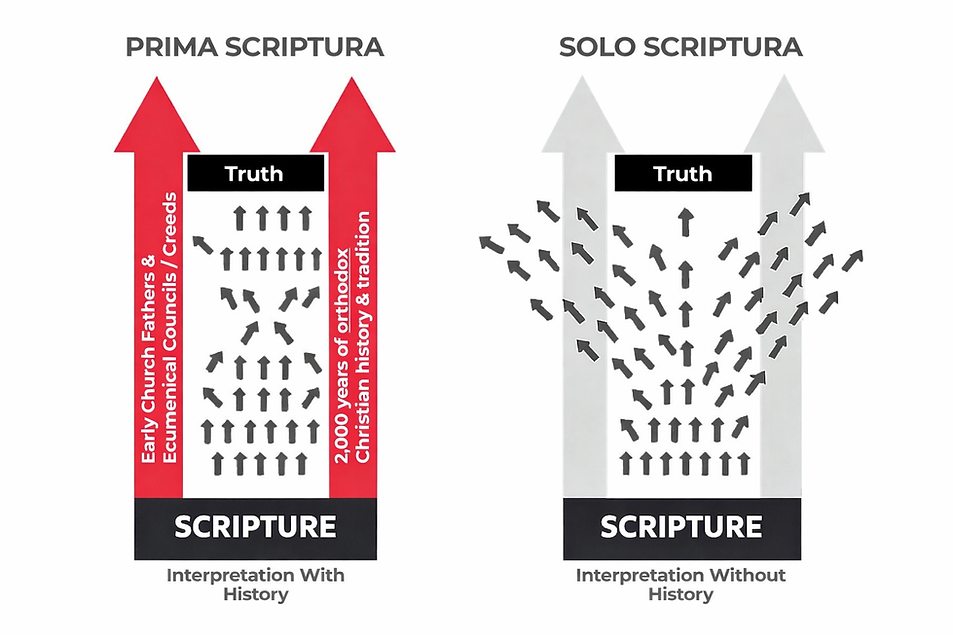
It is the living continuation of the very Church that Christ founded, safeguarded by generations of believers who received the faith directly from the apostolic foundation. Sola Scriptura has drifted to be practiced as Solo Scriptura.
If you’re trying to find the interpretation of something, and there’s no direct interpretation in Scripture, the obvious place to start is with the earliest interpreters of the spoken teachings and written text.
Apostolic and early Church tradition does not compete with Scripture—it helps us see Scripture accurately.
If a doctrine was universally taught by:
-
The apostles
-
Their disciples
-
The early Fathers
-
The entire undivided Church
…then any modern interpretation contradicting that consensus is almost certainly wrong.
This is why the earliest interpreters are higher authority than the latest theologians of today.
Ignatius, Polycarp, Irenaeus, Athanasius, Clement, Justin Martyr, Chrysostom, etc... lived in the world of the apostles; modern interpreters do not.
Scripture is infallible, but our 21st Century interpretation of Scripture is not!
The Early Church Fathers, Ecumenical Councils, Ecumenical Creeds, along with 2,000 years of orthodox Christian interpretation, history, tradition, and teaching function as a set of guardrails to ensure that we interpret it correctly.
The Problem With Modern Fragmentation
The New Testament warns repeatedly that false teachers would arise, and Christians would:
-
“accumulate for themselves teachers to suit their own likings” (2 Tim. 4:3)
-
reject sound doctrine
-
wander into myths
When Christians disregard connection to the early church, the results are predictable:
-
contradictory doctrines
-
new theological innovations
-
competing interpretations of Scripture
-
endless splintering into smaller denominations
1 Timothy 6:20
O Timothy, guard what has been entrusted to you. Avoid the godless chatter and contradictions of what is falsely called knowledge
2 Timothy 4:3-4
3 For the time is coming when people will not endure sound teaching, but having itching ears they will accumulate for themselves teachers to suit their own likings, 4 and will turn away from listening to the truth and wander into myths.
-
This is how denominations, which are completely cut off from the early church, teach doctrines which contradict the teachings of early founders of Christ's church
-
Sacrificing the Truth which was passed down, to make room for teachings that are easier to digest in our 21st Century culture.
Why Modern “Bible-Only” Interpretations Fail
Without context, lingual clarity, history, and apostolic teaching, Sola Scriptura in 21st-century American Christian practice becomes:
“Whatever I, or my group, think this verse means.”
This is how we've arrived at:
-
45,000+ Protestant denominations
-
Doctrinal chaos
-
Conflicting interpretations of virtually every major doctrinal issue
-
Individual Christians forming private theological systems disconnected from early church history
The early Christians would not have recognized this. They had no category for a church:
-
Without bishops
-
Without apostolic succession
-
Without sacramental authority
-
Without continuity of doctrine
The earliest believers judged all teaching by one standard:
Does it match the faith handed down from the apostles through apostolic succession?
Luke 10:16
16 “He who hears you hears me, and he who rejects you rejects me, and he who rejects me rejects him who sent me.”
Read More:
.png)


