


A Church History Series: Early Church Fathers – Polycarp
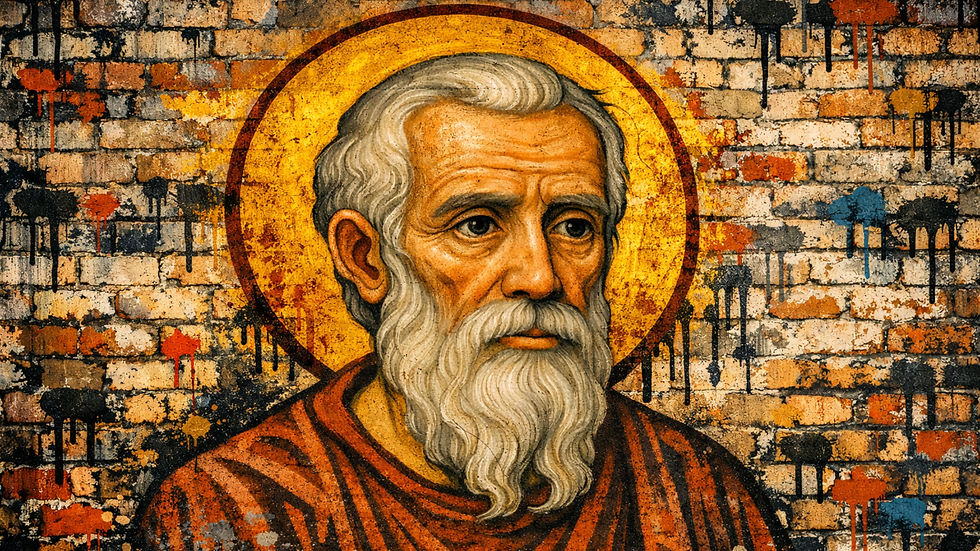
Guardian of Apostolic Truth and Model of Christian Courage
Polycarp of Smyrna (c. AD 69–155) stands as one of the most compelling figures of early Christianity—a bridge between the original Apostles and the developing Church, a defender of orthodox doctrine, and a martyr whose courage still inspires believers today. As an important Apostolic Father, he represents continuity, conviction, and unwavering faith.
A Bishop Formed by the Apostles
Polycarp served for decades as the Bishop of Smyrna, in what is now modern Izmir, Turkey. Polycarp was a direct disciple of the Apostle John himself. According to Church Fathers like Irenaeus and Jerome, John not only taught Polycarp but ordained him as bishop.
Polycarp would later become a spiritual mentor to Irenaeus of Lyons, one of the great theologians of the next generation. Through these relationships—John to Polycarp to Irenaeus—Christian teaching was faithfully carried from the Apostles to the early Church.
The Epistle to the Philippians: A Window Into Early Christianity
Only one of Polycarp’s writings has survived: his Epistle to the Philippians. Despite its brevity, it provides a rich glimpse into the life of the second-century Church.
In this letter, Polycarp:
Encourages steadfastness in the faith
Offers pastoral advice on Christian conduct
Quotes or alludes to many New Testament books, revealing how widely they were already used and respected
Warns against false teachings, especially the Gnostic belief of Docetism, which denied the real humanity of Christ
Polycarp’s writing displays a deep commitment to the apostolic message and to the unity of Christian teaching.
The Martyrdom of Polycarp: Faith in the Fire
The defining moment of Polycarp’s life came near its end. Around AD 155, during the reign of Emperor Marcus Aurelius, he was arrested for refusing to worship the Emperor or deny Christ.
The early Christian text The Martyrdom of Polycarp—one of the earliest accounts of martyrdom outside the New Testament—describes his extraordinary composure. When urged to save himself by cursing Christ, the aged bishop replied:
“Eighty and six years I have served Him, and He has done me no wrong. How then can I blaspheme my King who saved me?”
He was sentenced to be burned alive, yet the narrative describes the flames arching around his body rather than consuming it. Eventually, an executioner ended his life by stabbing him. His martyrdom became a powerful model for generations of Christians facing persecution.
A Champion Against Heresy
Polycarp lived in a time of growing doctrinal confusion, as early heresies challenged the apostolic faith. He responded with clarity, courage, and conviction.
Opposition to Gnosticism
Gnosticism was a broad movement claiming that salvation came through secret knowledge (gnosis). Polycarp spoke out decisively against its key teachings, including:
Docetism: This view taught that Jesus only appeared to be human and that His life, death, and resurrection were mere illusions. Polycarp fiercely defended the truth of the Incarnation, insisting that anyone who denied Christ’s real humanity was an “antichrist.”
Cerinthianism: Linked to the teacher Cerinthus, this version of Gnosticism claimed that Jesus was only a man and that the divine “Christ spirit” temporarily descended on him. Polycarp’s rejection of Cerinthus was so strong that, according to Irenaeus, he once fled a bathhouse upon seeing Cerinthus inside, declaring that the building might collapse because such a “enemy of the truth” was present.
Battle Against Marcionism
Marcion of Sinope developed another influential heresy, and Polycarp opposed it just as vigorously. Marcion promoted:
Two Gods: A strict dualism distinguishing the God of the Old Testament from the God of the New Testament
A reduced Bible: Marcion rejected the Old Testament entirely and edited the New Testament to remove passages he disliked
Polycarp’s response was unequivocal—he famously called Marcion “the firstborn of Satan.” His letter to the Philippians also defends the unity of God and the full humanity and divinity of Christ.
Polycarp’s Enduring Legacy
Polycarp’s life represents the steadfast faith of the early Church. His importance lies in:
His direct connection to the Apostle John
His transmission of apostolic teaching to figures like Irenaeus
His pastoral care and practical wisdom
His bold refutation of heresies threatening Christian unity
His courageous martyrdom, which inspired countless believers
Through his words and his witness, Polycarp helped preserve the integrity of the Christian faith at a pivotal moment in history. He remains a powerful example of perseverance, fidelity, and love for Christ—even unto death.

Comments